|
|
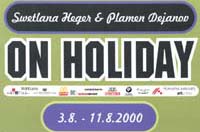
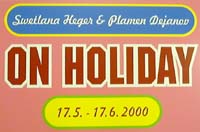
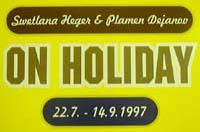
(...)Repeated every year since 1997, the On Holiday project no doubt represents the most important aspect of their work, clarifying as it does the reasons for their choices and their ideas about work-as-value and the "complex commodity" that is art. The principle is simple: they use the production money for an exhibition to go on vacation, leaving only a sign indicating the dates of their holidays, which are the same as those of the exhibition. By offering this principle to the Berlin gallerist Mehdi Chouakri and his assistants, and then inviting Florence Bonnefous and Edouard Merino to meet them on a liner for a cruise during the period of the exhibition at the Air de Paris gallery, they extended this principle of using the production budget to take paid vacations to their professional partners, thereby completely upsetting the usual working rhythms and creating supplementary free time. Heger & Dejanov have brought into play a new dialectic of the modes of production. When they take on the new capitalist insistence on a flexible workforce, they turn its perversity against itself in order to create favorable living and working conditions for themselves. Based on informal exchange, their economy sidesteps the regulations. Their working process chooses to work with rather than against the principles of liberalism in order to try to make this hegemonic system more bearable. The redistribution of free time allowed by more wide-ranging projects strikes me as indicative of the astuteness of their position, which one would judge, a priori, to be paradoxical. Taking advantage of their status within the art system, they will soon be in a position to produce literally "industrial scale" amounts of free time in response to an institutional commission. Which of course raises one or two problems for the managers. For the reversal of capitalist principles here is eminently subversive. Excerpt
from "Swetlana Heger & Plamen Dejanov, Art Workers" |